- Pick what you need and give your kitchen's ZIP code.
- Each service goes to the number of local companies you choose, from one to five. We check licenses where the law requires one and email you their names.
- You talk with them and decide. You hire and pay the company directly.
Facts checked 2026-11-02.
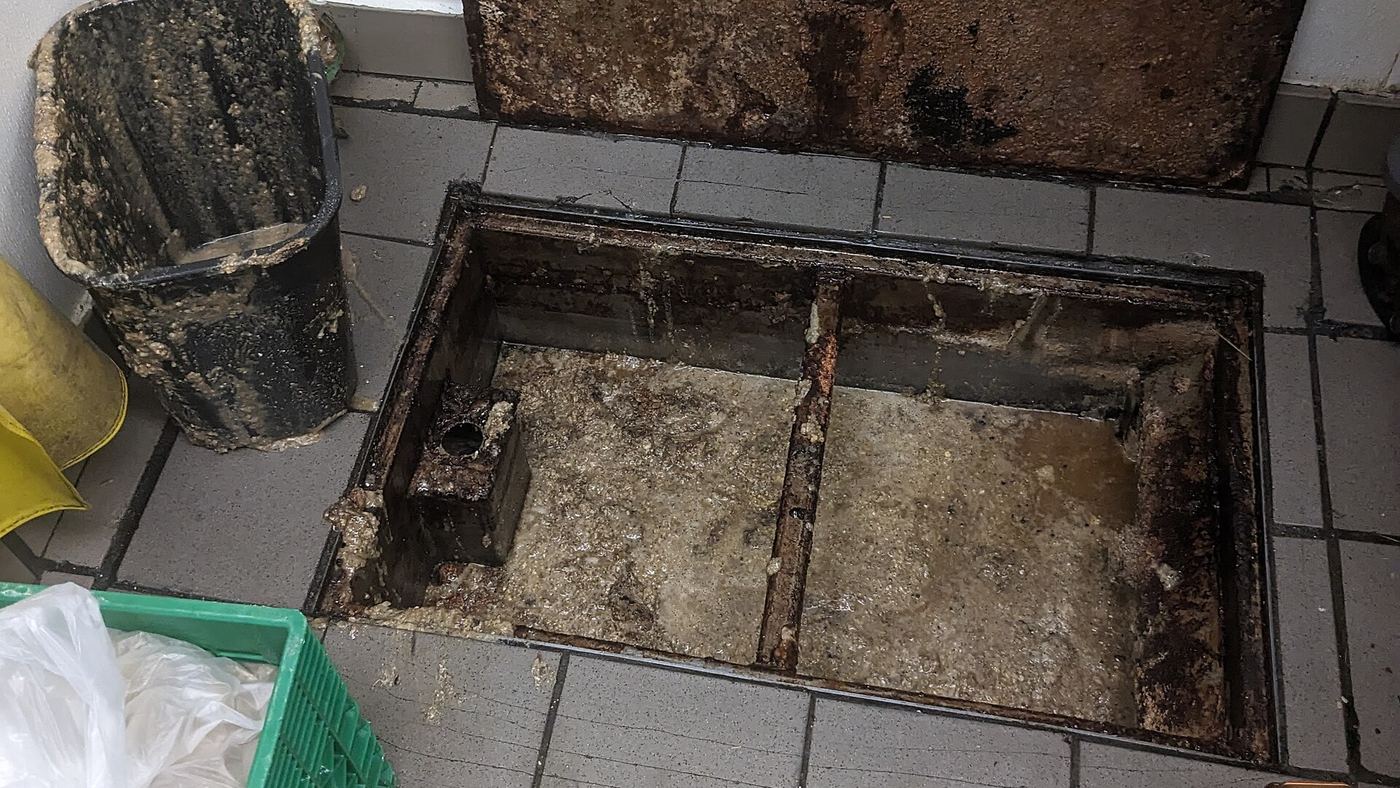

In Texas, your city or its wastewater utility decides how a grease trap is installed and how often it is pumped. The state agency, the Texas Commission on Environmental Quality (TCEQ), regulates the haulers that pump the waste. Houston requires a full pump-out every 90 days unless it approves a waiver. Dallas's undated poster says every 90 days, or sooner when 25% of the trap's wetted height holds grease or solids. Check the current rule with the city.
Local rules for the trap, state rules for the hauler
TCEQ says grease trap installation is regulated by local ordinances, the local wastewater utility, or both. A trap is required for any facility whose business sends cooking grease or oil toward the sewer, in areas that have adopted a plumbing code. Size and installation follow the local plumbing code. TCEQ does not require traps to be registered with the state, but a city may.
At the state level, TCEQ regulates pumping, transport, use and disposal of grease trap waste under 30 TAC chapter 312, and the facilities that process it under chapter 330. It has no authority over what a hauler charges.
How often to pump
TCEQ has a model standard that cities may adopt. It is not a state mandate, and each city decides. The model says:
- A trap is completely emptied at least every 90 days.
- It is emptied sooner when 25% or more of its wetted height holds floating material, sediment, oils or grease, measured from the bottom to the outlet.
- A city may grant an exception to the 90 days, but never beyond 180 days.
- Nothing may be put in the trap to break up grease. That means no surfactants, solvents or emulsifiers.
- Self-cleaning is allowed only with city approval, and only for traps of 50 gallons or less inside a building.
Houston and Dallas both use the 90-day interval. Pump frequency elsewhere depends on trap size, how much waste the kitchen makes, the maker's advice and the local ordinance.
A local company can take it from here. One form, free for restaurants.
Get connectedUsing a registered hauler
Only a hauler registered with TCEQ can legally pump and transport grease trap waste. The hauler follows 30 TAC chapter 312, subchapter G. To check a hauler:
- Ask to see the hauler's Notice of Registration from TCEQ.
- Look for an unexpired authorization sticker on the truck door. The hauler needs both.
- Or use TCEQ's Sludge Transporter Query, or call the Sludge Transportation Registration Program at 512-239-6413.
Registrations expire on August 31 and are renewed every two years. The registration must be kept at the business and in each vehicle.
A pump-out must empty the trap fully. If the trap is larger than the truck tank, the hauler must bring extra capacity so the trap is emptied within 24 hours.
The manifest, or trip ticket
Each pump-out comes with a manifest. TCEQ lists what it holds:
- the generator's name (that is you)
- the trap's capacity and type
- the amount pumped
- the date and time
- the hauler's TCEQ registration number
- the permit or registration number of the facility that received the waste
You sign it, and you should get a final copy signed by the generator, the hauler and the receiving facility. TCEQ says the generator is responsible for the waste until it reaches the proper disposal facility and could be held responsible for improper disposal.
How long to keep it depends on the city. The TCEQ model and Houston say five years, and a Dallas poster says three. Follow your own city.
Houston's permit and quarterly pump-outs
The Houston Health Department issues a Special Waste Generator permit to restaurants. It runs one year from the food dealer permit date and is renewed each year. Houston requires every interceptor inside city limits to be fully emptied at least every quarter unless a Notice of Waiver is approved. Manifests are kept on site for five years.
Inspections are unannounced, and the inspector looks at the permit, manifests, any waiver and the dumpster and oil bin area. Citations run $250 to $2,000 per violation. Houston has proposed lowering its oil and grease discharge limit, but that was not adopted on the date this page was checked.
Dallas hauler permits and the city poster
Dallas Water Utilities' Liquid Waste program inspects grease-generating facilities, tracks waste through manifests and permits haulers. The rules are in Dallas City Code chapter 19, article X. A grease trap is required for any commercial or institutional food service operation. The city's poster for food service establishments says to pump 100% of the trap at the earlier of every 90 days or when 25% of its wetted height holds grease or solids. It also says to use a hauler permitted by the City of Dallas. A Dallas hauler needs the TCEQ registration first and then a city permit for each vehicle. See the Dallas County page for more.
What to ask a hauler
- Is your TCEQ registration current, and is the sticker on this truck?
- Do you hold the city permit if I am in Dallas?
- Where does the waste go?
- Will I get the signed manifest copy?
Grease trap pumping is one of the choices on the form, and a request with a Texas ZIP code goes to the number of local companies you choose (one to five).
Questions
How often must a restaurant grease trap be pumped in Texas?
The TCEQ model standard says every 90 days, or sooner when 25% of the trap's wetted height holds grease or solids. Houston requires it every quarter, and Dallas's poster says every 90 days or at that 25% mark. Your city sets the rule where you are.
Does a grease trap hauler need a state registration in Texas?
Yes. Only haulers registered with TCEQ can legally pump and transport grease trap waste. Ask to see the registration and look for the sticker on the truck.
Who is responsible if grease trap waste is dumped illegally?
TCEQ says the generator is responsible until the waste reaches the proper disposal facility and could be held responsible for improper disposal.
Can I clean my restaurant's grease trap myself in Texas?
Only if your city allows it. The TCEQ model allows self-cleaning with city approval for traps of 50 gallons or less inside a building.